

–––––––


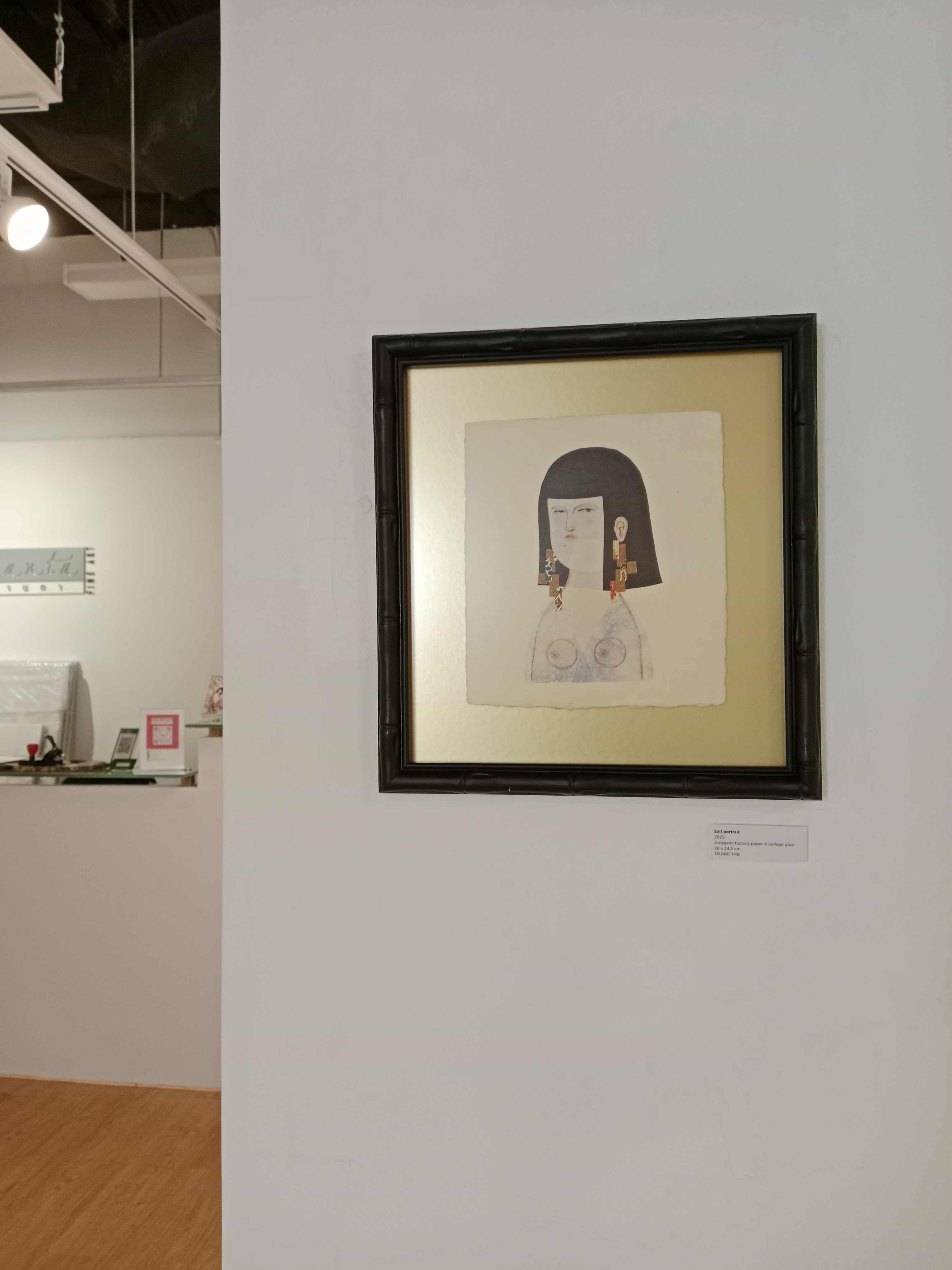
Cupsize 34B
— Salisa to Anton, August 26th, 2025


–––––––

We are driven by the scrupulousness of our reason into an atrocious unscrupulousness of our hearts.
— Musil


–––––––
–––––––
Come with flute and come with pipe!
Am I not ripe?
I, who wait and writhe and wrestle
With air that hath no boughs to nestle
My body, weary of empty clasp,
Strong as a lion and sharp as an asp —
Come, O come!
I am numb
With the lonely lust of devildom.– Aleister Crowley, Hymn to Pan
Would things have been any different – much simpler and less taxing and outrageous and convoluted – […] had he been the man seated behind me that night and I made the conscious decision to just turn around? To turn or not to turn.. I went to war with myself but in the end decided to not turn. What if I’d just turned? What if it was him? […] What else has happened in the span of then and here that needed not happen had I just.. turned?
– Salisa, Journal: July 3rd, 2025
Well, that was a marvelously short run. Or more of a hobble or even a weak sputter. No, it wouldn’t have made a modicum of situational difference had I turned.
Speaking of that night at the concert, I have been thinking about the “striking, frighteningly handsome” chap (entry: June 1st). How to not understate his devastating look and charm? He looks exactly like the young Justin Theroux. The clean-shaven look with killer eyebrows and sleek black hair slightly unkempt. Oh boy, those eyebrows and those eyes and cheekbones. The chin however was more of a straight drop so much pointier lending him a much sharper killer look. The male muse of so many if not all of the world’s panty-dropping lady-boners. Indeed he was even more attractive than Justin Theoreux. Think Bradley Cooper with that slight soft emotional edge but with a debonair hint of that real bad-boy swag. He must be someone’s most prized Romeo stallion… or he could be a male model in-between gigs who just happened to walk into the bar that night. How rich and powerful do I have to be to be able to source such a male specimen – the male specimen – to be present at my party? I’ve read a few days ago that Charlize Theron just had one of the best fucks of her life with a young 26 year-old. He must be a real Romeo stallion. But then again, I’m not Charlize Theron.
Speaking of handsome Hollywood men, just found out that poor Julian McMahon son of the former Australian Prime Minister had croaked via a sudden onset of a highly aggressive cancer. Henry and I just enjoyed our Nip/Tuck run not long ago (season 1 to mid-season 2). He was a real Romeo stallion there too (Grace reading the clinical psychology title – “Arrested Development in the Adult Male” – after her in flagrante office walk-in in episode 5 is still one of the funniest scenes in any medium I’ve seen recently). I tried watching his FBI show a couple of months back but his character was so pedantic and spiritless. Heard his Dr. Doom arc on Fantastic Four and his half-demon king-of-the-underworld Cole on Charmed are much better.
Upon this a question arises: whether it be better to be loved than feared or feared than loved? It may be answered that one should wish to be both, but, because it is difficult to unite them in one person, it is much safer to be feared than loved, when, of the two, either must be dispensed with.
– Machiavelli, The Prince
[…] He did mention at the beginning of the call, however, that he went to the Sarah Brightman concert […] earlier in the day. She sang “a few songs” from The Phantom of the Opera. I told him I read the book. He asked “the original novel by Gaston Leroux?”. He said he’d also read it “ages, ages ago” but that he either didn’t remember much or he didn’t like it and said something to the effect of: “I must not be a book person then.” Perhaps he meant he wasn’t book-ish. Perhaps he didn’t take to the ending of the book version.
I rummaged through my old college notebooks after the call and snapped a page of the extracted quotes from Leroux’s novel and sent it to him. I deduced from the date I noted down some pages prior to these quotes being taken as well as the extracts from one book I distinctly remember having read before I met Sebastian that I must have read Phantom of the Opera some time between September to December 2017. I also watched afterwards what I remember to be a film […] it would be the 2004 one with Gerard Butler playing the Phantom. Also a musical and an adaptation of Andrew Lloyd Webber’s.
The quotes are:
“And you know that nothing can restrain Erik, not even Erik himself.”
“(swear what?) You know I never keep my oaths. Oaths are made to catch fools with.”
Below them at the bottom of the page a tilltilating Wildean snide tacked on at the tail end which would amuse him – perhaps:
“Wilde: America is the only country that went from barbarism to decadence without civilization in between.”
He responded with a heart emoji.
… in place of the hum and murmur of the summer, an infinite silence seemed to fall on all things, and the wood was hushed, and for a moment in time he stood face to face there with a presence, that was neither man nor beast, neither the living nor the dead, but all things mingled, the form of all things but devoid of all form. And in that moment, the sacrament of body and soul was dissolved, and a voice seemed to cry “Let us go hence,” and then the darkness of darkness beyond the stars, the darkness of everlasting.
– Arthur Machen, The Great God Pan
Did you know that the word “panic” originated from the fear of the God Pan? Pan-ic: “god causing sudden mass terror or fright.” Indeed, the Apollonian-Dionysian distinction is for the Nietzschean starvelings denuded of any life experiences. I raise you with the Daemonic-Divine amalgamation. Or what Rudolf Otto calls Mysterium Tremendum:
The feeling of it may at times come sweeping like a gentle tide, pervading the mind with a tranquil mood of deepest worship. It may pass over into a more set and lasting attitude of the soul, continuing, as it were, thrillingly vibrant and resonant, until at last it dies away and the soul resumes its ‘profane’, non-religious mood of everyday experience. It may burst in sudden eruption up from the depths of the soul with spasms and convulsions, or lead to the strangest excitements, to intoxicated frenzy, to transport, and to ecstasy. It has its wild and demonic forms and can sink to an almost grisly horror and shuddering. It has its crude, barbaric antecedents and early manifestations, and again it may be developed into something beautiful and pure and glorious. It may become the hushed, trembling, and speechless humility of the creature in the presence of—whom or what? In the presence of that which is a Mystery inexpressible and above all creatures.
[…]
‘The numinous’ infuses the rational from above, ‘the sexual’ presses up from beneath, quite wholesomely and normally out of the nature which the human being shares with the general animal world, into the higher realm of the specifically ‘humane’. But though the two things I am comparing are thus manifestly opposite extremes, they have a closely corresponding relation to that which lies between them, viz. the reason. For the quite special domain of the ‘erotic’ is only brought into existence as the reproductive instinct passes up out of the merely instinctive life, penetrates the higher humane life of mind and feeling, and infuses wishes, cravings, and longings in personal liking, friendship, and love, in song and poetry and imaginative creation in general. Whatever falls within the sphere of the erotic is therefore always a composite product, made up of two factors: the one something that occurs also in the general sphere of human behaviour as such, as friendship and liking, the feeling of companionship, the mood of poetic inspiration or joyful exaltation, and the like; and the other an infusion of a quite special kind, which is not to be classed with these, and of which no one can have any inkling, let alone understand it, who has not learnt from the actual inward experience of ‘eros’ or love. Another point in which the ‘erotic’ is analogous to the ‘holy’ is in having in the main no means of linguistic expression but terms drawn from other fields of mental life, which only cease to be ‘innocuous’ (i.e. only become genuinely erotic terms) when it is realized that the lover, like the orator, bard, or singer, expresses himself not so much by the actual words he uses as by the accent, tone, and imitative gesture which reinforce them.
The phrase ‘he loves me’ is verbally identical, whether it is said by a child of its father or by a girl of her lover. But in the second case a ‘love’ is meant which is at the same time ‘something more’ (viz. sexual love), and something more not only in quantity but in quality. So, too, the phrase ‘We ought to fear, love, and trust him’ is verbally identical, whether it refers to the relation of child to father or to that of man to God. But again in the second case these ideas are infused with a meaning of which none but the religious-minded man can have any comprehension or indeed any inkling, whose presence makes, e.g., the ‘fear of God’ some thing more than any fear of a man, qualitatively, not merely quantitatively, though retaining the essence of the most genuine reverence felt by the child for its father. And Suso means in the same way to distinguish ‘love’ and ‘love of God’, when he says:
‘There was never a string so dulcet-toned but ceased to sound if stretched to a withered frame; a heart poor in love can no more understand speech rich in love than a German can an Italian.’
– Rudolf Otto, The Idea of the Holy